

Class ambition and complex subjectivity in Dadayama
The screen loves a woman’s story, and we do too. From the groundbreaking first Sinhala talkie, Kadavunu Poronduwa (1947), right up to modern films like Ayu (2025), female characters have not just been in the picture, they have often been the picture. This series, Beyond Victimisation dives into the nuanced world of feminine subjectivity, agency and identity across selected Sinhala films. This series is not just about what women do on screen; it is about what they feel, think, and see captured by the lens.
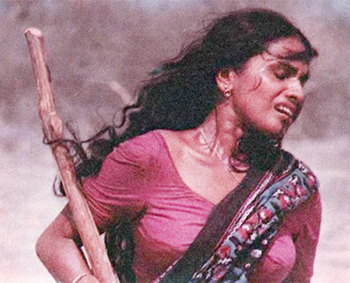
In Sinhala cinema, there are numerous examples of rural women characters, but ‘Rathamalee’ (Swarna Mallawarachchi) in the film ‘Dadayama’ by Wasantha Obeysekere holds a special place among them all. While ‘Dadayama’ has often been lauded as a ‘feminist’ film in the history of Sinhala cinema, this interpretation may easily overlook the depth of Rathmalee’s character.
The director skillfully brings out the subtleties of femininity by portraying how she can captivate a man’s desire and trap him, as well as her intense and almost hysterical determination to make him her own.

This multifaceted character’s subjectivity is a compelling aspect of the film that adds layers to the narrative. Unfortunately, most critics have focused on establishing the theme of the film as a feminist rebellion against patriarchal norms and have missed the nuances and complexity of the character’s role.
If we briefly examine the filmmaker’s objective in ‘Dadayama’, it becomes clear that the focus is on the relationship between Jayanath (Ravindra Randeniya), a young teacher who leads a self-indulgent and promiscuous life, and Rathmalee, a village girl who gradually becomes captivated by his image, demeanour, and affluent lifestyle.
Hailing from the petty bourgeoisie class and influenced by the norms of a market-driven economy, Rathmalee harbours ambitious desires of climbing the social ladder to attain an opulent lifestyle.
Her sole aspiration is to wed a young man whom she believes is capable of affording her a life of luxury and comfort. This reflects the perspective of a young woman with the aspirations and subjectivity often associated with the petite bourgeoisie.
This ambition often blinds her to or leads her to intentionally overlook Jayanath’s playful nature and deceitful ways. Her attraction to Jayanath stems more from his social class, physical appearance, and the material possessions like his car, rather than his sincerity or love for her.
Fuelled by her ambition to escape the daily struggles of life and embrace the prospect of a better life promised by the market economy, she is determined to possess Jayanath, almost as if making him her own, irrespective of his consent.
Rathmalee exhibits specific traits that underscore the inherent subjectivity prevalent in her petite bourgeois background. This subjectivity propels her to seek ways to transcend her circumstances. In this pursuit, she views Jayanath as a means to attain her desires. Her subjectivity becomes evident through the numerous dilemmas she encounters when driven by these needs.
In one of the film’s poignant moments, Rathmalee tells Jayanath in threatening tone, ”I will haunt you across lifetimes like an inescapable shadow. I will live for you and die for you.”
This statement by Rathmalee makes it clear that she is challenging Jayanath’s destructive actions and asserting her determination. Such a response is in line with the rural social values, as being a mother without a legal husband is deemed an ‘irreparable sin’ in that society.
Rathmalee’s sole purpose is to have Jayanath at any cost and marry him because, according to these social values, it is believed that her child needs a father, and she can attain the life she desires by adhering to the societal marriage norms. Rathmalee’s ambitious desires are, however, detrimental to her own self.
In the end, Rathmalee is much more than just a woman fighting against a man; she represents the desperate struggle to escape poverty. Her tragedy is not just that Jayanath is a villain, but that she is so blinded by her desire for a wealthy, high-status life that she ignores the danger she is in.
By showing her as a woman driven by both a need for social respect and a hunger for material things, the film becomes more than just a feminist story, it becomes a deep look at how social class affects our choices. Rathmalee’s fight is not about changing the world; it is about her doomed attempt to find a place in a high-society world that does not want her. This makes her one of the most complex and memorable characters in Sinhala cinema.
https://www.sundayobserver.lk/2026/01/11/spectrum/69503/beyond-rebellion