

The Golden Age rises again: Sri Lankan cinema’s 12 restored masterpieces shine
Sri Lankan cinema is currently experiencing an absolute renaissance, securing back-to-back local and international recognition.
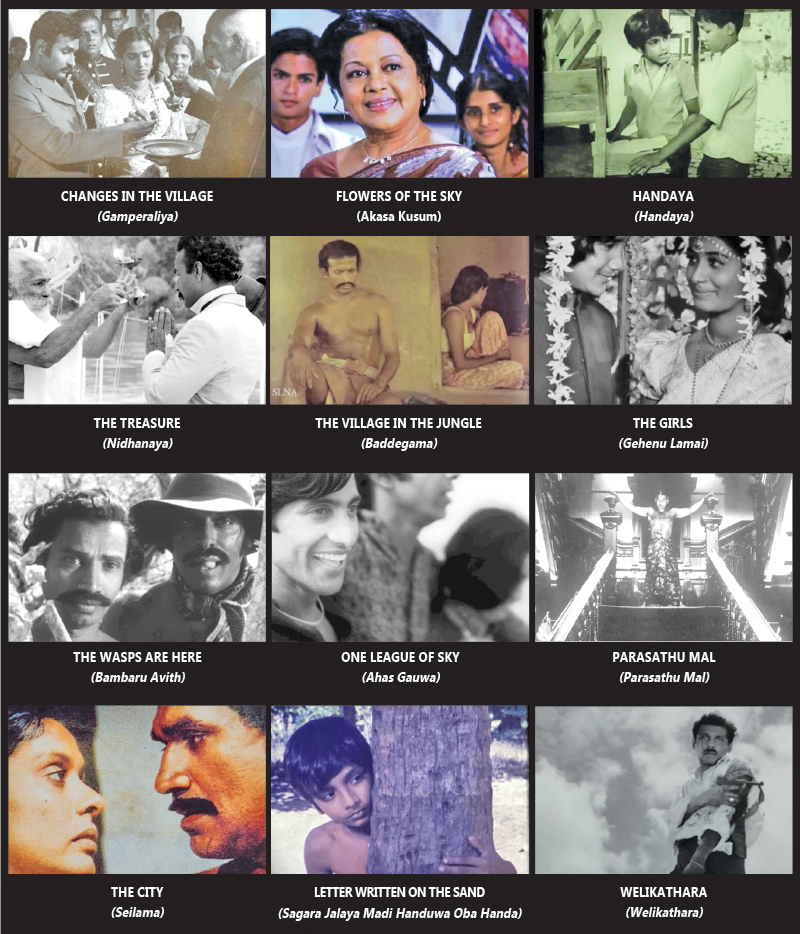
The 47th Festival des 3 Continents (France) is highlighting this resurgence by dedicating an exceptional program, aptly titled “On the road of the Golden Age of Sri Lankan Cinema,” to one of South Asia’s least-known film industries. This rare line-up of 12 featured works, including several newly restored prints, stems from a vital collaboration launched in April as part of the France–India–Sri Lanka Cine Heritage (FISCH) project with the National Film Corporation (NFC) and the Sri Lanka National Archives (SLNA).
The retrospective coincides with the landmark 4K restoration of Sumitra Peries’ masterpiece, The Girls (Gehenu Lamai, 1978), undertaken by the Film Heritage Foundation. The full selection of films includes: Gamperaliya (1963) by Lester James Peries, Akasa Kusum (2008) by Prasanna Vithanage, Handaya (1979) by Titus Thitawattha, Nidhanaya (1970) by Lester James Peries, Baddegama (1980) by Lester James Peries, Gahanu Lamai (1978) by Sumithra Pieris, Bambaru Awith (1978) by Dharmasena Pathiraja, Ahas Gauwa (1974) by Dharmasena Pathiraja, Parasathu Mal (1966) by Gamini Fonseka, Seilama (1993) by H. D. Premaratne, Sagara Jalaya Madi Haduwa Oba Handa (1988) by Sumitra Pieris, and Walikathara (1971) by D. B. Nihalsinghe. The festival commenced in Nantes, France, on November 21st and will conclude on November 29th, 2025.

Jerome Baron
Observer Muse had the exclusive opportunity to interview the man behind the selection, Jerome Baron, the Film Programmer and Artistic Director of the Festival des 3 Continents, whom we first met during his visit to Colombo for the “Archiving the image: From conservation to the screen” workshop earlier this year.
Q: There are 12 Sri Lankan films lined up under the banner “Golden Age”. What were the main criteria for defining the cinematic period referred to as the “golden age” of Sri Lankan cinema for this festival?
A: The “Golden Age,” generally spanning the mid-1960s to the mid-1980s, was defined by a convergence of creative breakthroughs and cultural self-discovery.
During this period, there were various approaches to cinema happening simultaneously. Young filmmakers were creating their first works, bringing a very innovative and personal approach. This was crucial for building a new audience, as the Sri Lankan public, especially in the 60s, was truly discovering its own cinema. Before independence, films were mostly made by or for the colonizers.
The films aimed to create an image of the Sri Lankan people and establish narratives that were very local yet sometimes universal at the same time. This era also launched a decisive star system, as some actors became very famous, very quickly, and remained cultural icons and landmarks of Sri Lankan cinema for a long time. A key example is the late Malini Fonseka, who passed away in May.
It is interesting to note how each film often had a precise way of approaching and reflecting the transformation, evolution, and contradictions of Sri Lankan society. While dynamism exists today, it was particularly prevalent and dynamic during these two decades and a half. I refer to it as a “Golden Age” not necessarily in terms of industry size — because Sri Lankan cinema has always been a small industry concerning resources and studio capacity — but in terms of creativity, inspiration, and dynamism, where many foundational things happened.
Q: It is a known fact that Sri Lankan cinema is one of the least recognized cinemas compared with the other South Asian countries in the international film festival scene. What are the primary historical, economic, or logistical reasons why Sri Lankan cinema has been less recognized internationally compared to its South Asian counterparts?
A: The difficulty in gaining widespread international recognition is intrinsically linked to several factors, beginning with the country’s “islander dimension” and the enormous presence of its neighbours.

The most significant obstacle is the colossal Indian cinema industry — what you might call the “Indian monster industry.” This industry has historically provided images, narratives, and content for the entire subcontinent and much further afield, reaching North Africa to Southeast Asia, producing hundreds or even a thousand films per year. It is immensely difficult to assert your own attraction and unique singularity when faced with such a massive production and diffusion model right around you.
This challenge mirrors the case of Taiwanese cinema, which was only truly “discovered” internationally in the 1980s, leading to a later rediscovery of its earlier works.
The other major reason is a linguistic and cultural barrier. The Sinhala language has a relatively small, contained speaker base globally. It is much more difficult to achieve broad traction when you don’t belong to a larger, connected cultural environment. For instance, French, Italian, and Spanish films historically reached neighboring European audiences quite easily because they were operating within a similar or connected cultural background.
This is not the case for Sri Lanka, both because of its geography as an island and the cultural particularity and linguistic singularity of its dominant language. This combination has made it harder for Sri Lankan cinema to break into the international film scene.
Q: Is the relative lack of recognition connected to issues of film preservation, restoration, or the accessibility of prints, especially from the ‘Golden Age’?
A: Yes, absolutely. This is the second aspect — the next level — of the lack of recognition: how to successfully promote films abroad at festivals and cinematheques when you don’t have a clear policy for preservation, restoration, and effective publicity of what you have to offer.
I believe we might be at a turning point now, as some recent initiatives could represent the first steps toward a better or larger restoration plan. This effort is important not just for the international audience, but primarily for Sri Lankans themselves, because this heritage is a part of their history. It is crucial for people to have and share their own memory, and we know that cinema in the 20th century played a very important role in that collective memory.
In that sense, preserving this heritage is fundamentally a local question, as it belongs to all the Sri Lankan community and people. Yet, it is simultaneously essential to be able to promote and showcase your own history and cultural activities to the global world. The two things are intrinsically linked.
This process requires time: people must be trained, and the necessary technology must be organized to manage restoration, preservation, and establish a consciousness of the country’s film heritage. It takes time to lay the groundwork with competent individuals who have the knowledge, curiosity, and desire to serve this cause. While private efforts might help, I believe it must primarily be driven by a public policy.
Q: Given the festival’s focus on Africa, Latin America, and Asia, what thematic or stylistic connections do you see between the featured Sri Lankan cinema and films from the other “three continents”?
A: My initial approach is always to consider each cinematography for its singularity and its own internal process. However, I do see significant connections, particularly between certain Sri Lankan films from the 1960s — the “villager films” or “jungle films” — and emerging African cinema of the same period.
This is the most evident connection because the social topics and core problems were strikingly similar. While the environments, social patterns, and behaviors are different — Africa is a vast continent, with great geographical distance between regions like China and South Africa — the societies were facing exactly the same structural challenges and obstacles in trying to define their present projects and future perspectives. Though Sri Lankan social patterns might differ from, say, some tribal or village organizations in Africa, a character appearing in a Sri Lankan film often strikes me as being incredibly similar to one I might have seen in an African film from the late 60s or early 70s.
These connections are also rooted in shared logistical realities. The resources, in terms of technology, budget, and overall capacity, were often of the same proportion. In places like Africa, there were no formal film schools, and in Sri Lanka, people were largely training each other, building up competencies film by film. Some individuals were trained abroad, but the process of accumulating expertise was similar. At a certain level, the production history and even some story themes can definitely be compared with the history of cinema from, for instance, the West Coast of Africa.
Q: What is the long-term vision for the FISCH project? Will it be focusing on restoring more films, and if so, how is the priority list being determined?
A: The FISCH project was initiated through the opportunity provided by two specific embassies — the French embassy in India and the French embassy in Sri Lanka — to use a budget for supporting cinematic initiatives. Such plans are often open for a defined period, typically one, two, or three years. Whether the current project will have direct continuity is uncertain.
However, the long-term hope is that, even if it is not under the “FISCH” name in the future, other initiatives will emerge to foster collaboration among people interested in restoring heritage in Europe, India, and Sri Lanka. This international collaboration is a key part of the vision.
The recent workshop in Colombo was designed precisely to facilitate this by bringing together people with existing competence to explain the processes, needs, and steps required to initiate film or photo collection restoration. The goal is to build up the necessary knowledge and competencies for a future plan.
I believe that international collaboration can be crucial in helping to build more ambitious budgets. When local investment resources or public capacity are insufficient, grouping two or three countries together with a collective perspective — defining what each partner brings — can be very encouraging and yield better results in a shorter term.
Therefore, the vision focuses on creating this system of international support and trained consciousness of the film heritage, which takes time to establish through a process of finding competent people with the knowledge and desire to serve this cause. Ultimately, while it may involve private efforts, it should ideally be driven by a public policy.
Q: What is the desired takeaway for a non-Sri Lankan audience encountering these films for the first time?
A: The desired takeaway is one of discovery and enriched perspective. For many in the non-Sri Lankan audience, this retrospective is coming “from nowhere,” even if a few people are familiar with the work of Lester James Peries and Sumitra Peries, whose films were screened here previously. I believe this will be a major rediscovery for them.
Fortunately, the festival’s audience is not typical; while many audiences prefer to watch what they already know and feel assured by familiar landmarks, ours is quite the opposite. They genuinely seek out things they have never heard about — they love this kind of challenge.
Therefore, the main hope is to contribute to giving them a better and more vivid portrait of what Sri Lankan cinema was during the “Golden Age,” even though the retrospective is limited to just 12 films. Looking ahead, I hope that with future restoration efforts, we can follow up on this initial showing and bring these works out more regularly, not just in this region of France, but for a wider diffusion.
We’ve specifically reached out to the Sri Lankan community in France — which is largely concentrated around Paris — by sharing information with various associations that promote Sri Lankan culture, history, and patrimony. I sincerely hope that some members of the community will travel to attend the screenings as well.